Winding
Around
A study of how visual perception is composed on the scenic parkway. Using Going-to-the-Sun-Road — the opening sequence of Stanley Kubrick's The Shining — as its test object, the paper traces two modes of looking at the same winding road: the director's aerial camera and the driver's embodied first-person view. Both, it argues, are The Rendered Reality — one through cinema, the other through landscape architecture.
The research sets scenic parkway design theory (P. L. Hornbeck's Highway Aesthetics, 1968; the U. S. Department of Commerce's A Proposed Program for Scenic Roads and Parks, 1966) against a frame-by-frame comparative analysis of Kubrick's eight opening shots. What emerges is a parkway that behaves like cinema — a linear garden whose foreground, middle ground, and background are choreographed for a viewer in motion, and which can be played forward or backward along its length.
Designing Going-to-the-Sun-Road
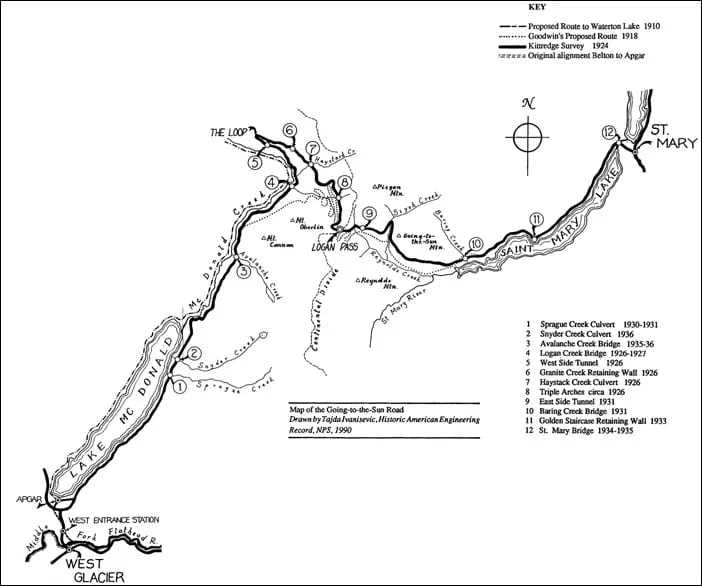
Going-to-the-Sun-Road, one of the earliest American scenic parkways, was built alongside the 1920s boom in automobile tourism. Its brief was modest: to offer an affordable, safe route through Glacier National Park, replacing the Great Northern Railway and its horse-drawn wagons. National Park Service chief engineer George Goodwin drew the first plan in 1918 — a sequence of fifteen switchbacks climbing the mountainside to Logan Pass.
During construction in 1924, landscape architect Thomas Vint objected to the switchbacks, saying they looked as if "miners had been in there." Engineer Frank A. Kittredge re-surveyed the area and settled the debate: a single hairpin — "The Loop" — carved into the cliff. What began as an engineering brief had become an aesthetic one. The road, before it was a road, was already a composed view.
Kubrick's Eight Shots
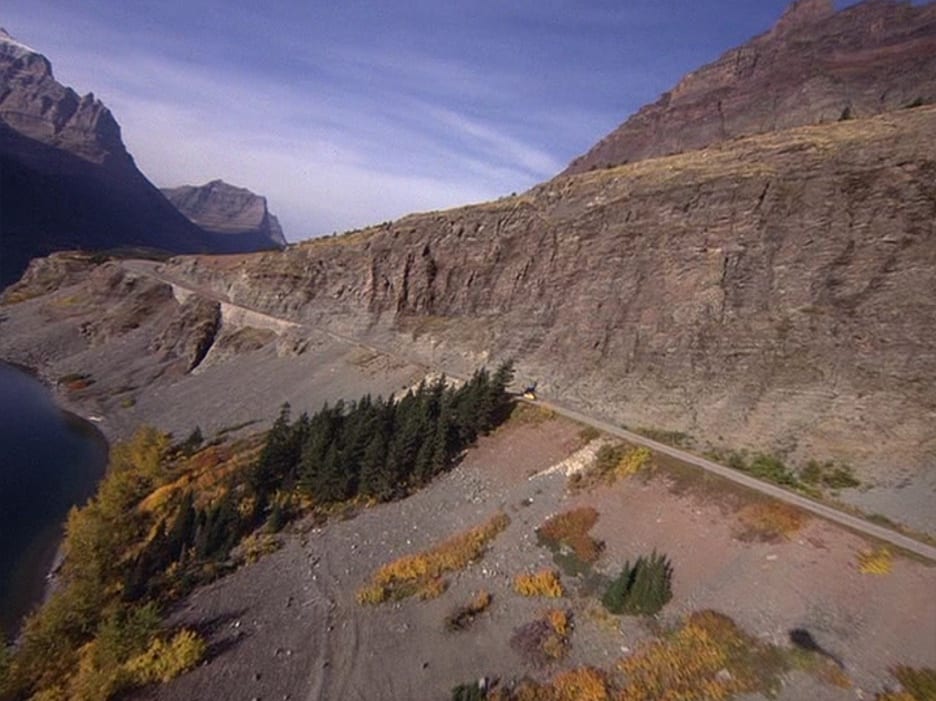
Kubrick used Going-to-the-Sun-Road as the opening of The Shining: a sequence of eight aerial shots linked by standard cuts and fades, tracing a small yellow Volkswagen Beetle along the winding road. Two details complicate the composition. First, Kubrick never set foot on the set — a lifelong fear of flying kept him in London, directing the helicopter crew by telephone. The result is the famous "lapse" at 1:11, when the helicopter's own shadow crosses the mountainside. Whether it was left in deliberately remains unresolved.
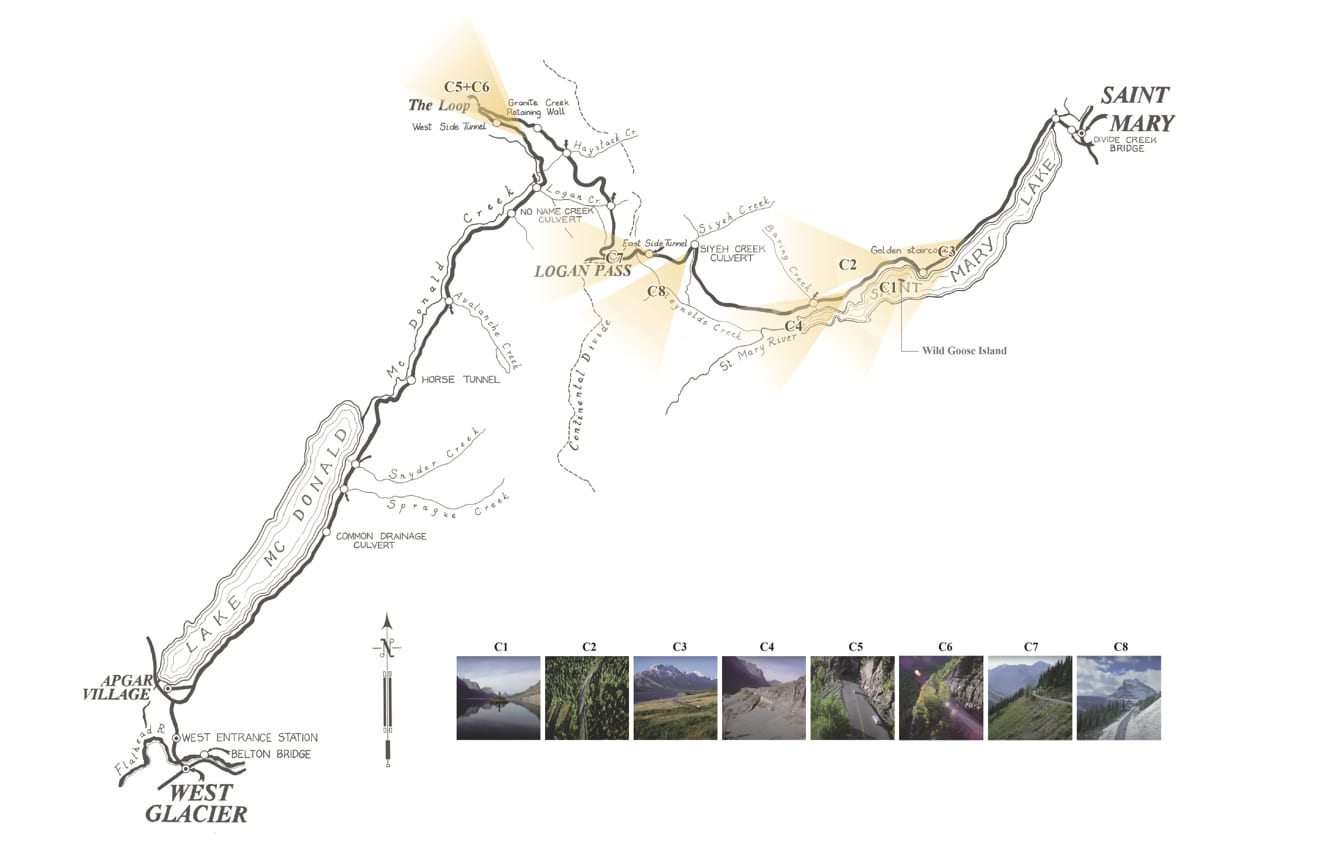
Second, the eight shots do not appear in the order a driver would encounter them. Traveling east to west — from Saint Mary Lake to The Loop — the actual sequence is C3 / C1 / C2 / C4 / C8 / C7 / C6 / C5. Kubrick recomposed the road. His camera altered Jack Torrance's hypothetical first-person perspective into a third-person aerial, building "an ominous mood" through the "vast isolation and eerie splendor of high mountains, and the narrow, winding roads which would become impassable after heavy snow." Neither Kubrick's view nor the driver's is objective: both are The Rendered Reality.
Designing the Driver's View
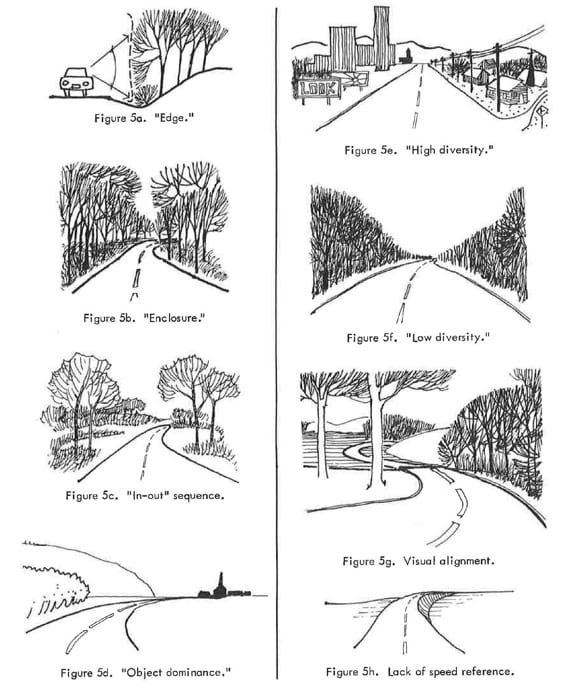
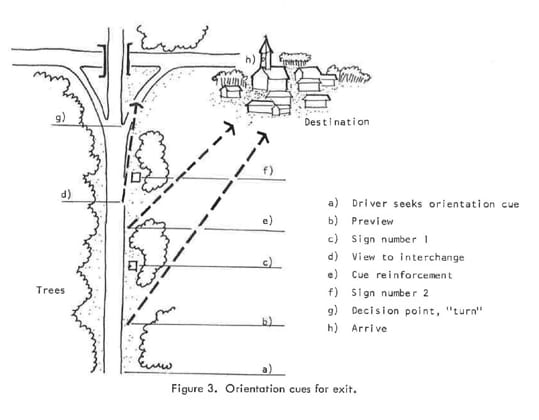
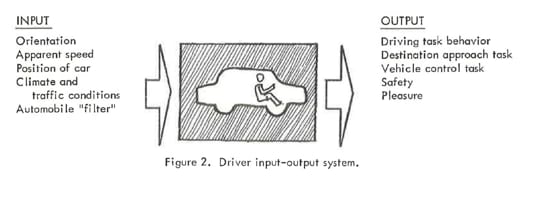
Scenic parkway design has its own literature. In the 1960s, P. L. Hornbeck treated the driver as an input-output system: inputs are spatial — edge, enclosure, visual alignment, framing — and outputs are behavioral — steering control, speed, attentional demand. A vista glimpsed after a sign "assists driver orientation and decision-making"; vegetation screens block distant views until the designer chooses to reveal them.
In 1966, the U. S. Department of Commerce's A Proposed Program for Scenic Roads and Parks formalized the Scenic Corridor: not the road alone, but the entire visual zone beyond the right-of-way — lakes, mountains, historical sites. The corridor is managed in three depths — foreground, middle ground, background — with the foreground doing most of the practical work: framing, concealing, then suddenly revealing.
Two Perspectives on the Same Road
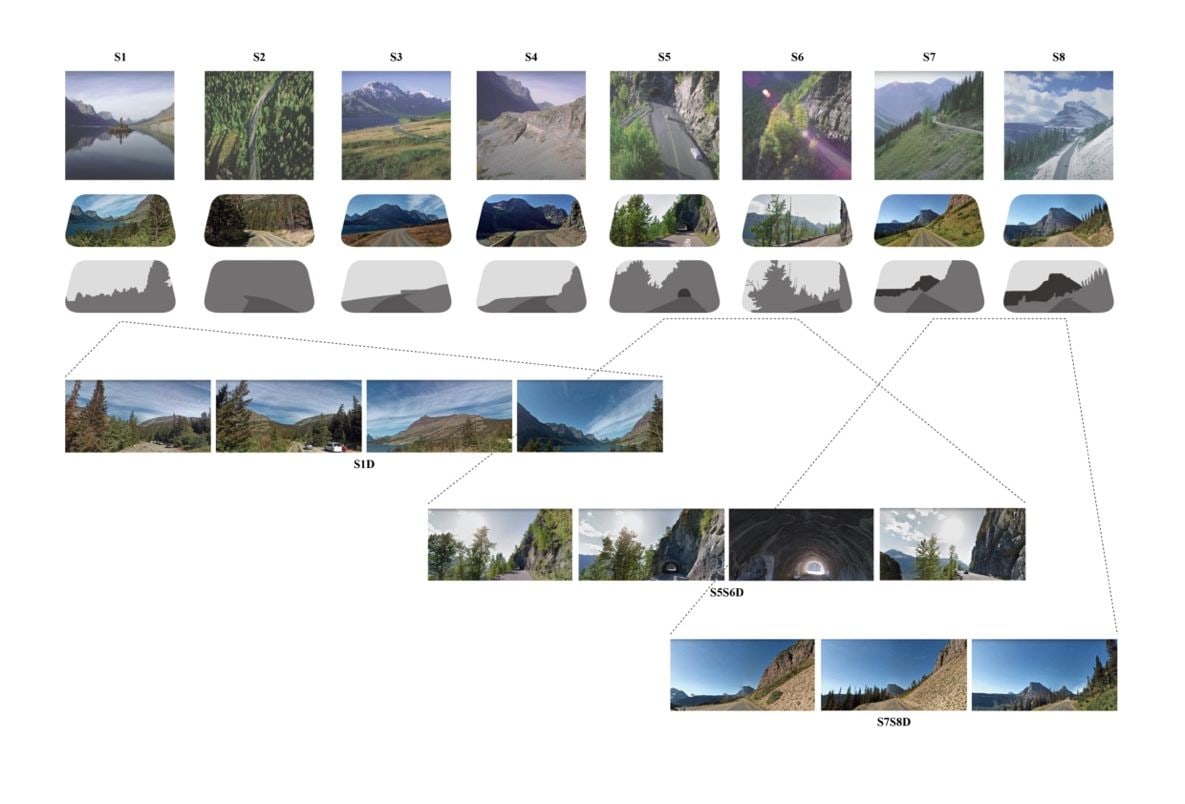
Three of the eight shots are set against the driver's actual visual experience along the same stretch of road (S1D, S5S6D, S7S8D). Each pair juxtaposes Kubrick's aerial composition with the foreground / middle ground / background analysis of the same scene from within the car. What Kubrick composes through the lens, the parkway composes through vegetation, alignment, and the timing of reveal.
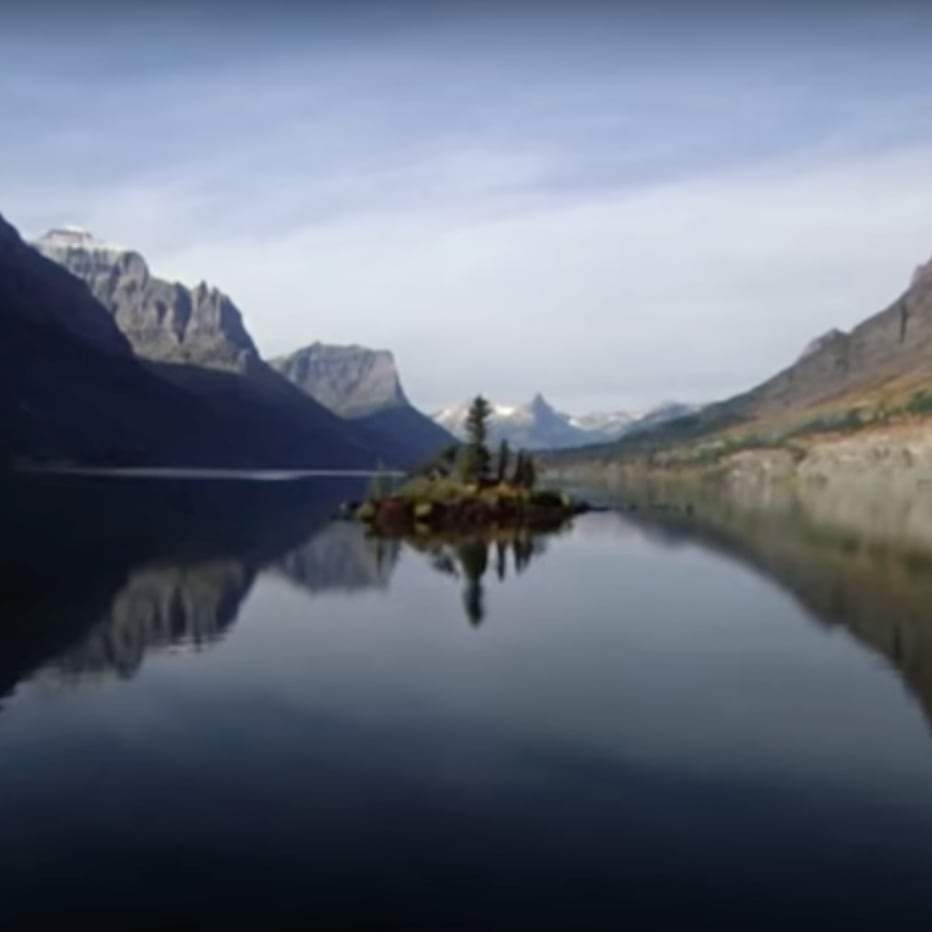
Kubrick's opening is a symmetric wide-angle shot of St. Mary Lake toward Wild Goose Island — a composition so rigorous it is unbalanced, the wide-angle lens bending the sides of the frame outward. The island at center reads as an omen of the isolated Overlook Hotel. From the driver's seat (S1D), the vista is initially blocked by vegetation; the view then opens suddenly, the island revealed at once. What cinema achieves through framing, the parkway achieves through timing.
The yellow Beetle disappears into, then emerges from, the West Tunnel. In the aerial, Kubrick even has rainbow lens-flare ornament the frame; the Beetle passes a station wagon pulled over, briefly quieting the viewer's worry about the family car. The tunnel interior is never seen from above. Inside the car (S5S6D), it is the experience: the space sequence light – dark – light is automatically "collaged" in the driver's mind from the two glimpses the aerial provides.
The closing two shots traverse high mountainous grassland across two different seasons — Kubrick splices them into one pass, signalling the winter closure of the hotel. In the car (S7S8D), only a single season is ever present; but the driver sees something the aerial cannot — as the road bends right, the middle-ground mountain widens and shifts to the left of the frame. The camera flies; the parkway pivots.
A Linear Garden for People in Motion
Through Kubrick's and Jack's perspectives, the same parkway becomes two different vehicles. One is a stage for the director's mysterious filming language and ominous soundtrack; the other, carefully — if quietly — composed by landscape architects and engineers: a linear garden for people in motion. Both are meticulously thought through. The subtleness of scenic parkway design is just like making a film; we can alter and manipulate the viewer's emotions whether they are in the theater or the Beetle.
Selected Sources
- Warren James Belasco. Americans on the Road, from Autocamp to Motel, 1979.
- Randi Minetor. Historic Glacier National Park, 2016, pp. 119–123.
- Gary D. Rhodes. Stanley Kubrick: Essays on His Films and Legacy, 2008.
- Michel Ciment. Kubrick: The Definitive Edition, 2003.
- P. L. Hornbeck, R. R. Forster, M. R. Dillingham. Highway Aesthetics — Functional Criteria for Planning and Design, 1968.
- U. S. Department of Commerce. A Proposed Program for Scenic Roads and Parks, Washington D.C., 1966.
- Robert Kolker. Rage for Order: Kubrick's Fearful Symmetry, 2010.
- Charlie Schmidlin. "Camera Operator for The Shining Explains Helicopter Shadows." 2013.
- "The Shining Opening — Shot-by-Shot Analysis." idyllopuspress.com.